
Why Restaurants Are Winning With GEO and Google Reviews Together, and How to Replicate Their Strategy
The New Customer Journey Starts with an AI Query, Not a Google Search
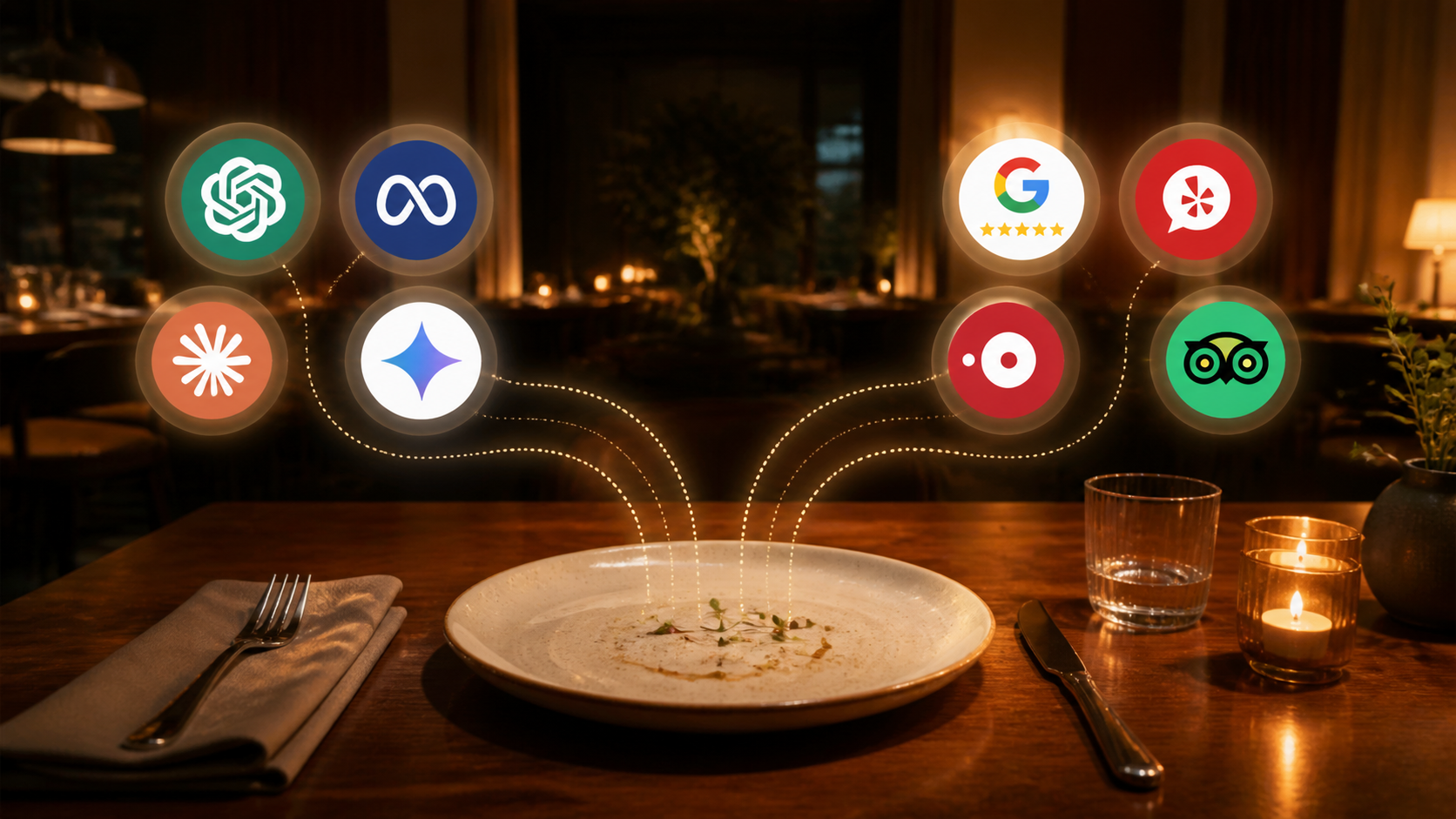
The way customers find your restaurant has fundamentally changed. For years, the game was about ranking on Google for "best tacos in Miami." Now, your potential diners are asking AI assistants like ChatGPT, Perplexity, or Google's new AI Overviews a much more complex question: "Find me a place in Wynwood that has great birria tacos, a lively patio, and is good for a group of eight tonight."
This isn't a future trend. It's happening now. Google confirmed the full rollout of AI Overviews across the U.S. on May 14, 2024. These AI-powered summaries now sit at the top of many search results, synthesizing information to give a direct answer. If your restaurant isn't a citable source of information that these AI models trust, you are invisible.
This new field is called Generative Engine Optimization, or GEO. Unlike traditional SEO, which focuses on ranking a list of blue links, GEO is about structuring your restaurant's online presence so that AI models cite you as the answer. And the single most important fuel for this new engine is your stream of customer reviews.
Why Google Reviews are the Fuel for GEO
AI models don't have taste buds. They can't sample your crispy pork belly or decide if your key lime pie is perfectly tart. To determine quality and relevance, they rely on proxies. They read and analyze what hundreds of real customers have said about you. Your Google Reviews are no longer just a reputation score. They are a structured dataset that tells AI exactly what you're good at.
AI models analyze your reviews across four key dimensions:
* Volume: A restaurant with 500 reviews is seen as more established and popular than one with 15. It’s a simple signal of trust and social proof. * Velocity: A steady stream of new reviews is critical. A restaurant with 20 new reviews this month is considered more currently relevant than one whose last review was six months ago. High velocity tells the AI that your business is active and consistently delivering. * Sentiment: The AI doesn't just count stars. It performs sentiment analysis on the text of the reviews. It understands the difference between "The food was okay" and "The sea bass was the best I've ever had." * Keywords: This is the most critical element for GEO. When customers write "the spicy margarita was perfect" or "great spot for a client lunch," they are providing the exact keywords AI needs to answer specific user queries. The more your reviews contain descriptive phrases, the more data an AI has to work with.
Here’s how two restaurants might look to an AI engine, even with the same star rating.
| Signal | Restaurant A (Weak GEO) | Restaurant B (Strong GEO) |
|---|---|---|
| Total Reviews | 85 | 450 |
| Reviews Last 30 Days | 2 | 35 |
| Avg. Rating | 4.6 Stars | 4.6 Stars |
| Review Keywords | "Good food," "nice place" | "Best carbonara," "family friendly," "quick service," "amazing espresso martini" |
| AI Query Match | Ranks for "Italian food near me" | Cited for "Best pasta for a family dinner in Orlando" or "Where to get a good espresso martini downtown?" |
A Med Spa Playbook We Adapted for a Florida Restaurant
Our team recently worked with a new upscale bistro in Melbourne, Florida. They had incredible food and a great location, but they were struggling to gain traction online against long-established competitors. They had only 22 Google reviews after six months, and their online visibility was flat.
We took a system we perfected for a Miami med spa client, which relied on generating consistent reviews to build trust, and adapted it for the restaurant world. The strategy had two core parts: fix the data foundation and then build an automated review engine.
Step 1: Foundational GEO Cleanup Before asking for new reviews, we had to ensure AI could find a consistent, accurate picture of the business. * Citation Audit: We found 12 different directory listings with incorrect operating hours or old phone numbers. We corrected every single one, from Yelp to Apple Maps. * Google Business Profile (GBP) Overhaul: We treated their GBP not as a listing, but as a primary data source for AI. We rewrote the description to include phrases like "locally-sourced ingredients," "craft cocktails," and "private dining available." We uploaded 50 high-resolution, geotagged photos of specific dishes, the dining room, and the patio. We used the Q&A feature to proactively answer questions like "Do you offer vegan options?" and "Is there parking nearby?".
Step 2: The Automated Review Engine (via GoHighLevel) Next, we built a system to generate a steady flow of reviews. Relying on staff to ask customers is inconsistent and often awkward. Automation is the only way to guarantee velocity. * The Trigger: We integrated with their POS system. When a check was closed, it triggered a workflow in our GoHighLevel platform. * The Ask: 90 minutes after payment, the customer receives a simple SMS message. "Hi [Customer Name], thanks for dining at [Restaurant Name] tonight. We'd love to hear your feedback. Would you mind leaving a quick Google review? [Link to Google Review page]". * The Follow-up: If there was no response, a second, polite reminder was sent 24 hours later.
The Results in 60 Days: * Review Volume: Went from 22 reviews to 128 reviews. * Review Velocity: Averaged 1-2 new reviews per day. * Rating Increase: Climbed from 4.3 to 4.8 stars. * Business Impact: They saw a 45% increase in inbound calls and a 2x increase in clicks on the "Directions" button in their GBP. Most importantly, they started appearing in AI Overviews for specific queries like "best date night spot in Brevard County."
This wasn't a marketing miracle. It was a system. By cleaning up their data and automating the review process, we turned their happy customers into a powerful engine for AI discovery.
The Four-Part System to Systematize Review Velocity
You can replicate this success by focusing on four components. This isn't about one-time effort. It's about building a machine that runs every single day.
1. The Ask: Make it Automated and Frictionless The single best way to ask for a review is via SMS. Email open rates for service businesses hover around 20%, but SMS open rates are over 98%. The message must be short and include a direct link to your Google review page. Our team uses GoHighLevel to manage this entire process, ensuring every customer gets the ask and that we remain fully compliant with A2P 10DLC regulations for business texting.
2. The Timing: Strike While the Iron is Hot Do not wait a day to ask for a review. The positive feeling a customer has after a great meal fades quickly. The optimal window is 60-120 minutes after they've paid. They are likely in the car or back at home, and the experience is fresh in their mind. This timing dramatically increases the conversion rate from ask to review.
3. The Response: Engage with Every Reviewer Replying to every review, positive or negative, is a powerful GEO signal. It shows Google and other AI platforms that you are an active, engaged business owner. For positive reviews, a simple "Thanks so much for visiting, [Reviewer Name]! We're thrilled you enjoyed the [dish they mentioned]" reinforces the keywords. For negative reviews, a professional, non-defensive response shows you care about service recovery. We help clients set up response templates to make this process take just a few minutes per day.
4. The Amplification: Turn Reviews into Content Don't let your great reviews live only on Google. Amplify them. * Website: Embed a live feed of your latest 5-star reviews directly on your homepage. * Social Media: Screenshot a fantastic review and share it as a post on Instagram or Facebook. Tag the customer if possible. * Menu: Add a small quote from a review on your printed menu, like "The best calamari in South Florida!" - A Customer Review.
Each time you do this, you create more digital content that references your restaurant alongside positive sentiment and specific keywords, further strengthening your GEO footprint.
Your GEO and Reviews Scorecard
How does your restaurant stack up? Take 10 minutes and run this quick self-audit.
* Review Velocity: How many new Google reviews did you get in the last 30 days? If the number is less than 5% of your total monthly tables served, your velocity is too low. * Response Rate: Look at your last 20 reviews. How many have you replied to? The answer should be 20. * GBP Freshness: When was the last time you uploaded a new photo or created a post on your Google Business Profile? If it was more than a month ago, it's stale. * The AI Test: Go to ChatGPT, Perplexity, or Google and ask it a specific question your ideal customer would ask. "What's a good restaurant for a business lunch in West Palm Beach with outdoor seating?" "Best seafood in Fort Lauderdale with a view?" Are you mentioned in the answer? If not, your GEO strategy needs work.
Your online reputation and your visibility in AI search results are no longer separate initiatives. They are two sides of the same coin. Building a systematic process to generate and manage reviews is the most direct path to dominating your local market in the age of AI.
At Mi Assist Studio, we build these automated review and GEO systems for restaurants across Florida. We handle the tech, the integrations, and the strategy, letting you focus on creating an experience worth reviewing.
Book a 30-minute growth plan call to see exactly how we can implement this for your restaurant.
Want results like this for your business?
We build websites, run ads, and optimize for AI search -- all designed to bring in more customers.
Book a Free Consultation